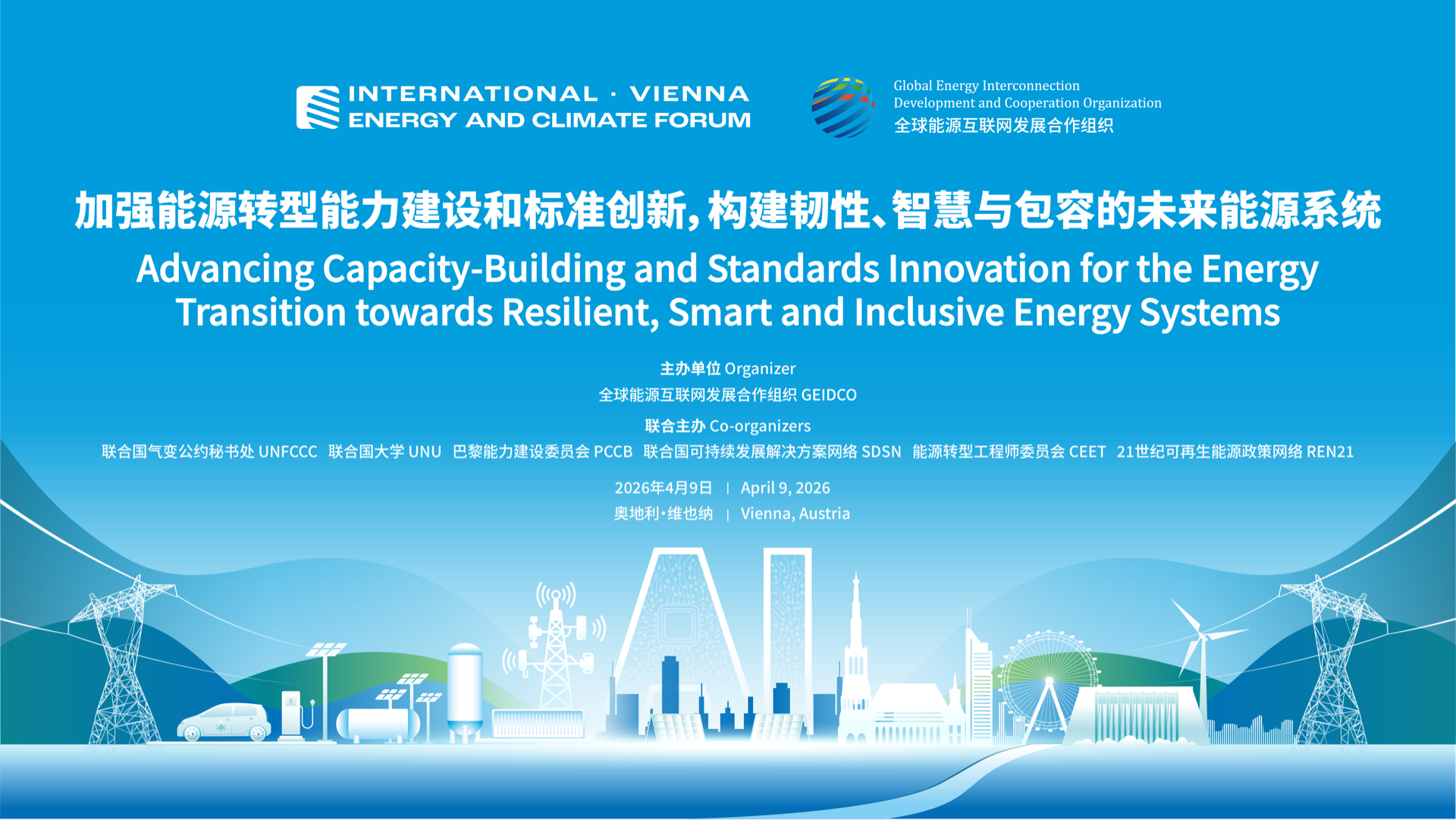
| Time | Content |
| Opening Remarks
Moderator: Mr. Wang Peng, Deputy Director General, Operations Bureau, GEIDCO |
|
| 16:30-16:55 | Mr. Xin Baoan, Chairman, Global Energy Interconnection Development and Cooperation |
| H.E. Ms. Rabab Fatima , Under-Secretary-General and High Representative for the Least Developed Countries, Landlocked Developing Countries and Small Island Developing States, United Nations |
|
| Prof. Jeffrey D. Sachs , President, UN Sustainable Development Solutions Network (SDSN) | |
| Mr. Riad Meddeb, Head of Decarbonization and Sustainable Energy, UNDP | |
| Capacity Building for the Energy Transition:
Release of Research Findings, Joint Initiative and High-level Dialogue Moderator: Mr. Alberto Sanchez, Senior Associate, UNU-VIE |
|
| 16:55-17:25 | Release of the Preliminary Research Findings of the Global Energy Transition Capacity-Building Gaps and Needs Assessment Presenter: Mr. Wang Qiankun, Head of Capacity Building, Operations Bureau, GEIDCO |
| Launch of the Joint Action Initiative on Capacity-Building for the Global Energy Transition Co-Initiated by GEIDCO, UNFCCC, PCCB, UNU, SDSN and REN21 Presenter: Ms. Liz Nelson, Program Manager, Council of Engineers for the Energy Transition (CEET) at SDSN |
|
| High-level Round-table: 1. Mr. Seleshi Bekele , Former Minister of Water, Irrigation and Energy of Ethiopia and Chairperson of the GEIDCO African Committee 2. Prof. Franz Josef Radermacher, Chairman of the Board of the Research Institute for Applied Knowledge Processing, member of the Club of Rome 3. Ms. Rana Adib, Executive Director, REN21 4. Mr. Alejandro Kilpatrick , Capacity-Building Subdivision, Means of Implementation Division, UNFCCC |
|
| Advancing Standards Innovation for the Energy Transition Moderator: Ms. Gabriela Ehrich,Chief Representative for the International Development of GEI Standards |
|
| 17:25-17:55 | Introduction to GEIDCO’s GEI Standards Framework and Key Achievements |
|
Panel Discussion 1. Mr. Ashish Jindal, Senior Officer, India at SEforALL 2. Mr. Lyu Kunlun, Chief Representative of Central and Eastern Europe, Henan Pinggao Electric Co., Ltd. 3. Mr. Zhou Mingyu, Technical Expert and Staff Engineer, China Electric Power Research Institute (CEPRI) and Global Energy Interconnection Research Institute Europe GmbH 4. Mr. Du Yan, Deputy Director, Power Source Technology Center, State Grid Shanghai Municipal Electric Power Company 5. Mr. Li Tan, Director, Laboratory Management Department, DC Technology Consulting Center, State Grid Economic and Technological Research Institute |
|
| Closing Remarks | |
| 17:55-18:00 | Mr. Zou Ciyong, Deputy to the Director General and Managing Director of the Directorate of Technical Cooperation and Sustainable Industrial Development, UNIDO |
Agenda
Global Action Initiative on International Cooperation for
Capacity Building in the Energy Transition
Capacity Building in the Energy Transition
At present, the global energy transition is moving from vision to implementation. Capacity building has become a fundamental pillar for advancing a just energy transition and building sustainable energy systems. However, significant gaps remain across regions and countries in areas such as policy, technology, project development, and financing capacities, calling for more systematic and coordinated support.
In this context, we jointly launch this Initiative, with the aim of promoting a more coordinated, efficient, and impactful global capacity-building system for the energy transition:
In this context, we jointly launch this Initiative, with the aim of promoting a more coordinated, efficient, and impactful global capacity-building system for the energy transition:
1 Strengthening Global Cooperation Mechanisms for Capacity Building
Building on the mechanism of the Paris Committee on Capacity-building (PCCB) Network Energy Cluster, we will enhance strategic coordination, knowledge exchange, and joint action among governments, international organizations, enterprises, research institutions, and financial institutions. Regular annual dialogues and progress assessments will be conducted. We will also promote experience sharing and technology transfer among developing countries, supported by developed countries and international organizations, to scale up capacity-building efforts globally.2 Co-developing the Global Energy Interconnection Academy
We will jointly develop the Global Energy Interconnection Academy into an open and inclusive global platform for capacity building across regions. The Academy will strengthen collaboration and resource-sharing with relevant training platforms within the United Nations system, international organizations, universities, and research institutions. Through joint training programmes, seminars, workshops, and masterclasses, the Academy aims to reach tens of thousands of energy professionals worldwide each year.3 Promoting Knowledge Sharing on the Energy Transition
We will jointly develop training resources and establish an open and shared knowledge system on energy transition. We will conduct joint research on global capacity gaps and needs for the energy transition, providing a scientific basis for countries to formulate strategies, plans, and capacity-building programmes. Best practices and innovative solutions will be disseminated globally, while enhancing information exchange and knowledge sharing among international organizations, academic institutions, research bodies, and industry platforms.4 Mobilizing Resources and Ensuring Sustainable Investment
We will collaborate with multilateral development banks, climate funds, and private capital to establish mechanisms linking capacity building with project financing, thereby enhancing project implementation capabilities. Increased and sustained financial support for capacity-building initiatives will be encouraged, including the establishment of dedicated funds to support training and technical assistance programmes in developing countries.5 Promoting Inclusive Participation of Youth, Women, and Marginalized Groups
Youth and women will be prioritized in capacity-building efforts, with a strong emphasis on gender equality and intergenerational equity. Particular attention will be given to underrepresented and vulnerable populations, including those from least developed countries (LDCs), landlocked developing countries (LLDCs), and small island developing States (SIDS). Targeted training programmes will be established to empower these groups and support their active engagement in the energy transition.6 Strengthening Monitoring, Evaluation, and Continuous Improvement
We will establish monitoring and evaluation frameworks for capacity-building initiatives, including impact assessment systems and the regular publication of progress reports. The Global Electricity Development Index will be continuously updated to track progress and outcomes. Based on evaluation results, training content and cooperation mechanisms will be continuously improved to enhance effectiveness.
We call upon governments, international organizations, enterprises, academic institutions, and all sectors of society to work together in building an open, inclusive, and mutually beneficial global capacity-building system for the energy transition, contributing to the development of modern energy systems for the future.
We firmly believe that strengthened international cooperation in capacity building will accelerate a more efficient, just, and sustainable global energy transition, benefiting both present and future generations.
Co-Initiators
Global Energy Interconnection Development and Cooperation Organization (GEIDCO)
United Nations Framework Convention on Climate Change (UNFCCC) Secretariat
United Nations Industrial Development Organization(UNIDO)
Paris Committee on Capacity-building (PCCB)
United Nations University (UNU)
Sustainable Development Solutions Network (SDSN)
Renewable Energy Policy Network for the 21st Century (REN21)
Global Energy Interconnection Development and Cooperation Organization (GEIDCO)
United Nations Framework Convention on Climate Change (UNFCCC) Secretariat
United Nations Industrial Development Organization(UNIDO)
Paris Committee on Capacity-building (PCCB)
United Nations University (UNU)
Sustainable Development Solutions Network (SDSN)
Renewable Energy Policy Network for the 21st Century (REN21)



